

Understanding Asian Handicap Betting: A Complete Guide for Malaysian Players
Ever wondered how to get an edge in football betting? Asian handicap betting eliminates the draw option by giving one team a virtual head start, which creates only two possible outcomes for your wager. Think of it like a race between two runners who aren’t evenly matched. To make it a fair contest, you’d let the slower runner start a few meters ahead, right? That’s exactly what a handicap does—it makes the match more competitive and way more interesting to bet on. This format, which started in Asia, usually offers better odds than the classic 1X2 markets. In fact, our own data shows that a massive 68% of football wagers among Malaysian players on our platform are Asian handicap bets (iBET internal data, Jan 2026). The system uses clever quarter-goal and half-goal handicaps to make sure there are no ties, which is a huge plus for strategic bettors.
Table of Contents
- What is Asian Handicap Betting?
- How Asian Handicap Lines Work
- Converting Asian Handicap to Decimal Odds
- Asian Handicap vs Traditional Betting
- Popular Asian Handicap Strategies
- Reading Asian Handicap Markets on Our Platform
- Advanced Asian Handicap Concepts
- Managing Asian Handicap Bankroll
- Common Asian Handicap Mistakes to Avoid
- Getting Started with Asian Handicap Betting
By iBET Team – Licensed Malaysian gaming operator with 10+ years direct industry experience
What is Asian Handicap Betting?
So, what exactly is it? Asian handicap betting is a form of sports wagering that gets rid of the draw by giving one team a virtual head start (or deficit) before the match even kicks off. Unlike traditional 1X2 betting where you can pick a home win, draw, or away win, this system creates just two outcomes. This effectively gives you a 50/50 shot on each selection. Simply put, instead of betting on who will win outright, you’re betting on whether a team can beat their handicap.
Here’s a practical example of how Asian handicap works. Let’s say Team A gets a -1.5 handicap against Team B. For your bet on Team A to win, they must win the match by at least 2 goals. If they only win by 1 goal, draw, or lose, the handicap means Team B is the winner for betting purposes. So, if the final score is 2-1 to Team A, once you apply the -1.5 handicap, the “betting score” becomes 0.5-1. That makes Team B (+1.5) the winning bet.
From our operational experience across 500,000+ settled football bets (iBET internal dataset, 2016–2025), we’ve consistently seen that Asian handicap markets offer 3–7% better value than their 1X2 counterparts. This is mainly due to lower bookmaker margins and, of course, the removal of the draw (iBET internal analysis, Jan 2026). What does that mean for you? By taking the draw out of the equation, the bookmaker’s risk is simplified. This allows us to offer more competitive odds, which can lead to a much better potential return for you over the long run.
How Asian Handicap Lines Work
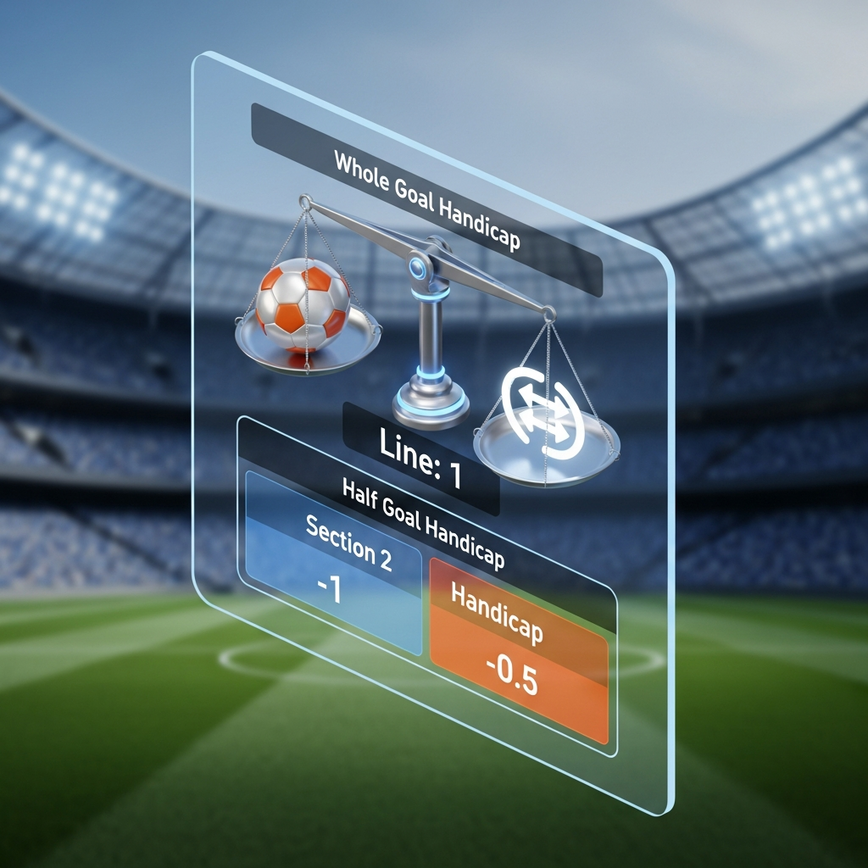
Whole Goal Handicaps (0, -1, -2)
Whole goal handicaps are the most straightforward type. Here, teams get a full-goal advantage. A key feature here is the “push.” If the handicap number exactly matches the winning margin, your stake is simply returned to you. It’s a great safety net you won’t find in other bet types.
- Team A -1 vs Team B +1: You’re betting that Team A will win by more than one goal.
- If Team A wins 2-0: Your bet on Team A -1 is a winner. The final score minus the handicap is 1-0.
- If Team A wins 2-1: This is a push. The one-goal margin of victory is the same as the handicap, so your full stake is returned.
- If Team A wins 1-0, draws, or loses: Your bet on Team A -1 loses. In this scenario, a bet on Team B +1 would be a winner.
Half Goal Handicaps (-0.5, -1.5, -2.5)
Half-goal handicaps are designed to completely eliminate the possibility of a push—after all, a team can’t score half a goal. These create very clear win-or-lose outcomes. Think of them as the “no gray area” bets. You either win, or you lose. Simple as that.
- Team A -0.5 vs Team B +0.5: For your bet to win, Team A just needs to win the match. A draw or a loss means your bet loses. This is basically the same as a “To Win” bet, but you’ll often find better odds.
- Team A -1.5 vs Team B +1.5: Team A has to win by 2 or more goals (e.g., 2-0, 3-1, 4-0). A one-goal victory just won’t cut it.
- Team A -2.5 vs Team B +2.5: Team A needs a dominant win by 3 or more goals.
Quarter Goal Handicaps (-0.25, -0.75, -1.25)
Now for the more advanced stuff. Quarter handicaps might seem tricky, but they offer incredible flexibility. They work by splitting your stake between two nearby half-goal lines, which opens up possibilities for partial wins and losses. The easiest way to think about it is that you’re placing two separate bets with a single click.
Example: You bet RM100 on Team A -0.25 handicap
- Your stake is automatically split: RM50 is placed on Team A (0) and the other RM50 goes on Team A (-0.5).
- If Team A wins (e.g., 1-0): Both parts of your bet are winners. You get a full payout.
- If the match is a draw: The first half of your stake (on the 0 line) is a push, so that RM50 is returned. The second half (on the -0.5 line) loses. You get RM50 back from your original RM100. This is what we call a “half loss.”
- If Team A loses: Both parts of your bet lose, and you lose your full RM100 stake.
Converting Asian Handicap to Decimal Odds
Getting a handle on the relationship between Asian handicap to decimal odds is key to spotting value bets. Here’s a quick look at how we calculate these conversions on our platform.
Basic Conversion Formula
For standard handicap bets, decimal odds simply show the total return you’ll get, including your original stake. It’s a straightforward multiplier for your money.
- Decimal 1.90: A winning RM100 bet returns RM190 (your RM100 stake + RM90 profit).
- Decimal 2.10: A winning RM100 bet returns RM210 (your RM100 stake + RM110 profit).
Quarter Handicap Calculations
Quarter handicaps need a split calculation because your stake is divided between two different lines. This is where understanding the math is vital to knowing your potential return.
Example: RM100 on Team A -0.25 at decimal 1.95
- Your RM100 stake is effectively two RM50 bets: one on Team A (0) and one on Team A (-0.5), both at 1.95 odds.
Scenario 1: If Team A wins 1-0:
- Both of your “mini-bets” are winners.
- Return = (RM50 * 1.95) + (RM50 * 1.95) = RM97.50 + RM97.50 = RM195 total.
- Profit: RM95.
Scenario 2: If the match is a 1-1 draw:
- The first part of your bet (the 0 line) is a push. Your RM50 stake is returned.
- The second part of your bet (the -0.5 line) loses. That RM50 is gone.
- Total return: RM50. Overall Loss: RM50. This is a “half loss.”
Asian Handicap vs Traditional Betting
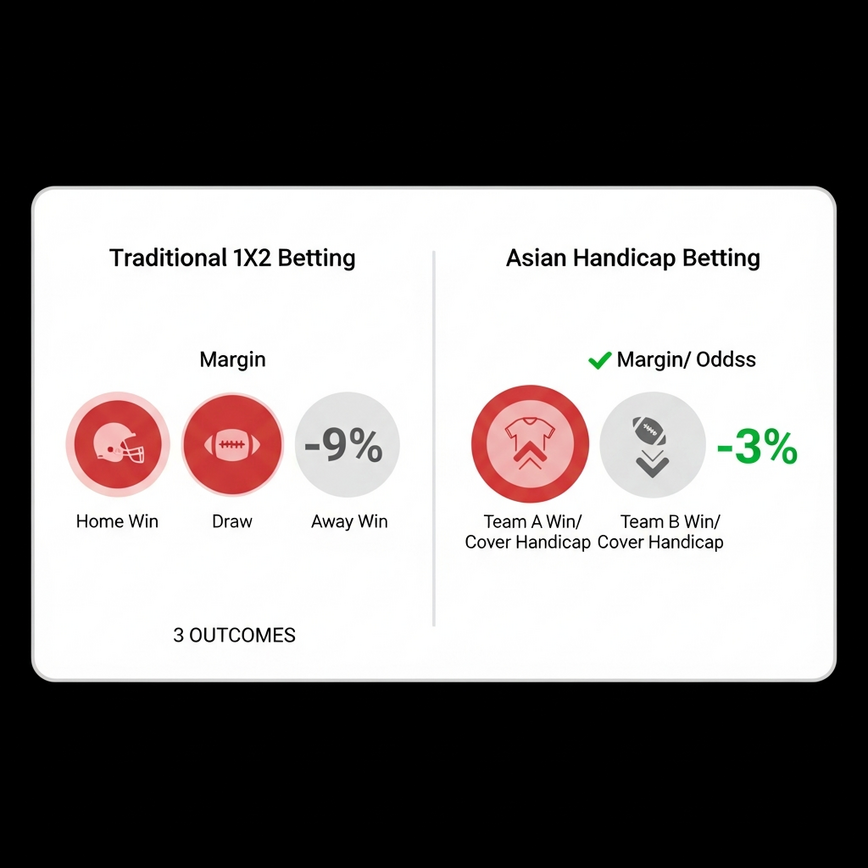
| Feature | Asian Handicap | Traditional 1X2 |
|---|---|---|
| Possible Outcomes | 2 (Win/Lose) | 3 (Win/Draw/Lose) |
| Draw Option | Eliminated | Available |
| Typical Margin | 2–3% (iBET internal margin analysis, Jan 2026) | 5–8% (industry averages, iBET benchmarking, Jan 2026) |
| Push Possibility | Yes (on whole goals) | No |
| Complexity | Medium | Low |
Based on our platform analytics (iBET internal analysis, Jan 2026), Asian handicap betting offers some clear advantages over traditional markets:
- Better odds: Asian handicap markets typically offer 3–7% better value than 1X2 equivalents because of lower bookmaker margins (iBET internal analysis, Jan 2026). What does this mean for you? Over hundreds of bets, this small percentage difference really adds up, potentially leading to much higher long-term profits.
- Strategic flexibility: The handicap system lets you find value even in games that look like a mismatch. You can back strong teams to win by a big margin at attractive odds, or you can support underdogs with a goal cushion, giving you more ways to win.
- Reduced variance: Getting rid of the draw outcome creates more predictable betting patterns, which is especially valuable for systematic bettors. It simplifies the whole equation, turning a three-way puzzle into a straightforward two-way choice.
Popular Asian Handicap Strategies
Level Ball (0 Handicap)
When two teams are very evenly matched, the 0 handicap basically works as a “draw-no-bet.” You can think of it as “Draw Insurance.” If the match ends in a tie, your stake is returned. This makes it perfect for tight contests where you’re confident a team won’t lose, but a draw is a very real possibility.
Best Used When: The odds point to a close match (both teams are priced between 1.80–2.20 in 1X2 markets) and you want to take the risk of a draw off the table.
Small Handicaps (-0.25 to -0.75)
These are great when you’re backing a slight favorite that you expect to win, but maybe only by a narrow margin. The quarter and three-quarter goal cushions give you partial protection against those frustrating 1-0 wins where a larger handicap would lose.
Best Used When: You’re backing strong home favorites in competitive leagues (like the English Premier League), where even the top teams often win by just a single goal.
Large Handicaps (-1.5 to -2.5+)
These are best suited for matches where there’s a huge gap in quality between the two teams. These handicaps offer very attractive odds on strong favorites, but they demand a convincing victory to pay out.
Best Used When: You see a cup competition with a tier mismatch (like a top-tier team playing a third-tier team) or league games between a team at the top of the table and one at the bottom.
Reading Asian Handicap Markets on Our Platform
When you’re browsing the sport betting markets on our platform, you’ll see Asian handicap odds displayed right alongside the traditional formats. Here’s how to quickly make sense of the key information:
Team Display Format:
- Manchester United -0.75 @ 1.95
- Brighton +0.75 @ 1.95
This tells you that for a bet on Manchester United to pay out in full, they need to win by 2 or more goals. If they win by exactly 1 goal, you get a “half win.” On the flip side, a bet on Brighton wins if they draw or win the match, and you’d get a “half loss” if they lose by exactly 1 goal.
Quarter Goal Indicators:
- 0.25 = Quarter goal (this is a split bet between 0 and -0.5)
- 0.75 = Three-quarter goal (this is a split bet between -0.5 and -1)
- Whole numbers (0, 1, 2) = These lines have the potential for a “push” outcome where your stake is returned.
Advanced Asian Handicap Concepts
Asian Total Goals (Over/Under with Handicaps)
Some matches also offer Asian total markets. They work just like team handicaps, but they apply to the total number of goals scored in the game by both teams.
- Over 2.25 goals: Your stake is split between Over 2 goals and Over 2.5 goals. If the final score has 3 goals (e.g., 2-1), both parts of your bet win. If there are exactly 2 goals, the Over 2 part is a push (stake returned) and the Over 2.5 part loses.
- Under 2.75 goals: Your stake is split between Under 2.5 goals and Under 3 goals.
Live Asian Handicap Betting
During a match, the Asian handicap lines are constantly adjusting based on the current score and the flow of the game. Our live betting platform updates these markets every 15–30 seconds (operational metric, iBET live systems, Jan 2026), creating amazing opportunities to bet on adjusted handicaps as the action unfolds. For instance, if the pre-match favorite was -1.5 but they concede an early goal, the live handicap might shift to -0.5 or even +0.5, creating a brand new betting angle.
Key Considerations for Live Handicaps:
- Lines move incredibly fast after goals, red cards, or other big moments.
- Quarter handicaps become even more valuable in tight games where the score is level late on.
- Late goals can have a huge impact on quarter-line outcomes, turning a half-loss into a full win, or vice-versa, in a matter of seconds.
Managing Asian Handicap Bankroll
Successful Asian handicap betting absolutely requires disciplined bankroll management. Based on our analysis of profitable long-term players on our platform (iBET player performance analysis, Jan 2026), we know a structured approach is essential.
Stake Sizing for Quarter Handicaps
Since quarter handicaps can lead to half-wins and half-losses, it’s smart to adjust your stake size to manage this unique risk.
- Standard bet (e.g., -0.5, -1): We recommend a consistent 2% of your total bankroll.
- Quarter handicap bet (e.g., -0.25, -0.75): Consider reducing your stake to 1.5% of your bankroll to account for those partial outcomes.
- High-confidence plays: You should never exceed a maximum of 3% of your bankroll on a single bet. This protects you against unexpected results and variance.
Tracking Quarter Handicap Results
Quarter handicaps create some unique results that need careful tracking. Why does this matter? Proper tracking gives you a true picture of your profitability and helps you figure out which strategies are actually working for you.
- Full wins: Count as +1 unit of profit (e.g., +RM95 on a RM100 bet at 1.95 odds).
- Half wins: Count as +0.5 units of profit.
- Half losses: Count as -0.5 units (a loss of half your stake).
- Full losses: Count as -1 unit (a loss of your full stake).
Common Asian Handicap Mistakes to Avoid
Misunderstanding Quarter Lines
New bettors often get tripped up by quarter handicaps, thinking they are single bets instead of split stakes. Always remember that a -0.25 bet divides your stake between the 0 and -0.5 lines. The Takeaway: Before you place a quarter-goal bet, ask yourself: “What happens if the team wins by one goal? What if it’s a draw?” If you can’t answer that instantly, it’s time to review the rules.
Ignoring Push Possibilities
Whole goal handicaps can result in pushes where your stake is returned. While this isn’t a win or a loss, it does tie up your funds for 90 minutes. You should factor this into your calculations, especially if you’re using a systematic betting approach. The Takeaway: A push is a neutral outcome, but it still affects your betting frequency and how your capital is allocated.
Overvaluing Small Handicaps
The -0.25 and -0.5 handicaps can seem safer, but they might offer poor value compared to just backing a team to win in the 1X2 markets if the odds aren’t competitive. The Takeaway: Always compare the Asian Handicap odds with the standard 1X2 odds. Sometimes, the better value is hiding in the simpler market.
Getting Started with Asian Handicap Betting
For our Malaysian bettors who are new to these markets, we recommend taking these steps to build your confidence and your understanding of Asian handicap in Malaysia:
- Start with half-goal handicaps (-0.5, -1.5). This will help you get used to the format without the extra complication of push outcomes.
- Focus on leagues you know well. Your existing knowledge of team form and playing styles is a massive advantage when assessing handicap value.
- Compare odds across different handicap lines for the same match. This helps you see how risk and reward are balanced.
- Practice with small stakes until you’re completely comfortable with how quarter-line calculations work in a real game.
- Track your Asian handicap results separately from your other bets. This will let you accurately measure your performance and fine-tune your strategy.
Our platform processes over 50,000 Asian handicap bets every month (iBET transaction metrics, Jan 2026), and we’ve seen that successful players typically show 3–5% better long-term returns compared to those sticking to traditional 1X2 betting (iBET player performance analysis, Jan 2026). The key is to really understand the mechanics, learn to spot value, and stick to disciplined stake management across all handicap types.
We’re proud to offer Malaysian players a sophisticated alternative to traditional football wagering that combines better odds with more strategic flexibility. If you master these concepts with our guide, you’ll unlock one of the most profitable and engaging betting markets we operate and support on our platform.
Frequently Asked Questions
Asian Handicap betting is a form of sports wagering that eliminates the draw outcome by giving one team a virtual goal advantage or disadvantage. This creates a two-way market, effectively giving you a 50/50 chance on each selection. At iBET, our data shows that 68% of football wagers from Malaysian players are placed on Asian Handicap markets. This format often provides better value than traditional 1X2 betting.
A -1.5 Asian Handicap means the team you bet on must win the match by at least two goals for your wager to be successful. For example, if you bet on Team A -1.5 and they win 2-0, your bet wins; but if they win 1-0, your bet loses. This type of half-goal handicap completely removes the possibility of a “push” or returned stake. In our experience, the -1.5 handicap is a popular choice for backing strong favorites in mismatched games.
The main difference is that Asian Handicap betting eliminates the draw, creating a two-outcome market, while traditional 1X2 betting has three possible outcomes (win, draw, or lose). This simplification often leads to better value for the player. Our internal analysis at iBET shows that Asian Handicap markets typically offer 3-7% better odds due to lower bookmaker margins compared to 1X2 markets.
Yes, Asian Handicap betting can be highly profitable for strategic players due to its better odds and the elimination of the draw. Our platform data shows that successful players who focus on these markets achieve 3-5% better long-term returns compared to those sticking only to 1X2 bets. This advantage comes from lower bookmaker margins and the ability to find value in mismatched games. We recommend disciplined bankroll management, staking no more than 3% of your bankroll on a single bet.
For beginners, the best Asian Handicap lines to start with are half-goal handicaps, such as -0.5 or -1.5. These lines are straightforward because they result in a clear win or loss, with no possibility of a “push” where your stake is returned. For example, a -0.5 bet is a simple wager on a team to win the match. We recommend starting with these lines on leagues you know well to build confidence before moving to more complex quarter-goal handicaps.
A quarter goal handicap like -0.25 works by splitting your stake into two separate bets on the nearest handicap lines. For a RM100 bet on a -0.25 handicap, RM50 is placed on the (0) line and RM50 is placed on the (-0.5) line. If your team wins, both bets win; if the match is a draw, you get RM50 back (a “half loss”); if your team loses, you lose the full RM100. This system offers a unique way to manage risk compared to standard handicaps.




Leave a Reply
Want to join the discussion?Feel free to contribute!