

Casino Hold’em: Rules and Strategy Guide
In our experience, Casino Hold’em is a fantastic poker variant where you compete directly against the house, not other players. When you use an optimal strategy, the house edge is only about 2.16% (based on our audited game-math report from 2026). So, what does that actually mean for you? It means that, on average, for every RM100 you bet over the long run, the casino expects to keep about RM2.16. This makes it one of the most player-friendly table games you can find.
Table of Contents
- What is Casino Hold’em?
- Basic Casino Hold’em Rules
- Casino Hold’em Payout Structure
- Essential Casino Hold’em Strategy
- Common Casino Hold’em Mistakes to Avoid
- Advanced Strategy Tips
- Practicing Casino Hold’em Strategy
- Responsible Gaming in Casino Hold’em
- Casino Hold’em vs. Other Poker Variants
- Conclusion
What is Casino Hold’em?
Ever wondered how Casino Hold’em works? Sometimes called Caribbean Hold’em, it’s a live casino poker game that popped up in the early 2000s. In our operations, we run this as a house-banked game, which is just a fancy way of saying you’re playing one-on-one against the dealer. Your only goal is to have a better hand than them. What the other players at the table are holding is completely irrelevant to your game. This is casino hold’em explained in its simplest form.
The game uses the same community-card format you know from Texas Hold’em but simplifies the betting to create a faster, more streamlined casino experience. We find it’s the perfect starting point for anyone who knows the basics of poker but doesn’t want to deal with complex things like bluffing or trying to read opponents.
Basic Casino Hold’em Rules
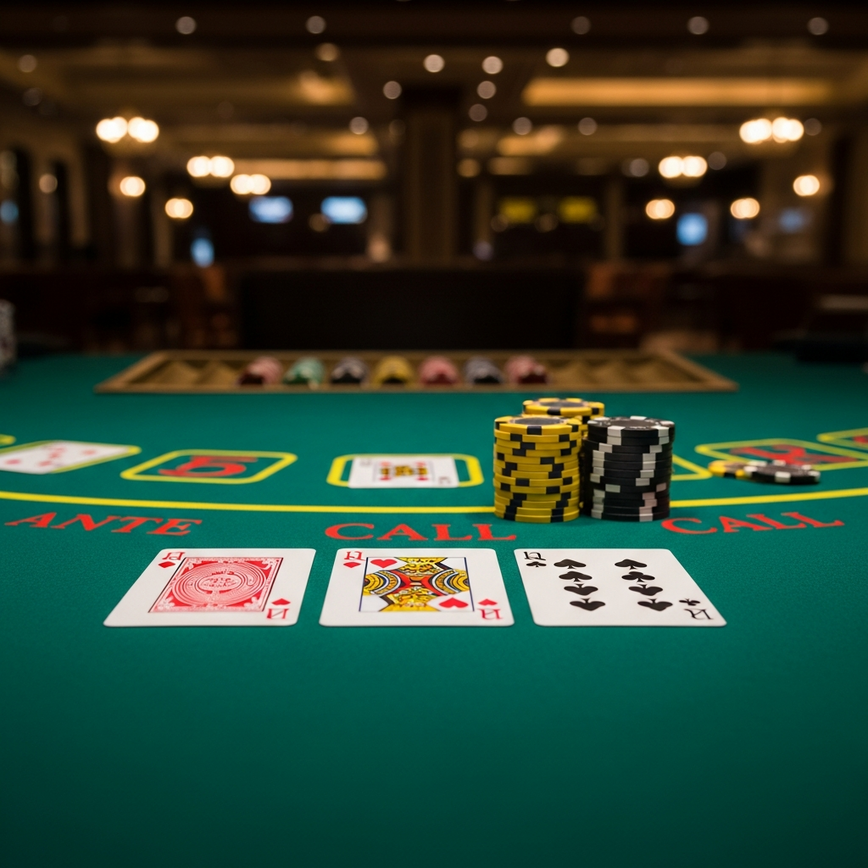
Ready to play? Here’s a breakdown of the casino hold’em rules malaysia players need to know.
Game Setup and Equipment
- The game uses a standard 52-card deck, which is shuffled before every hand.
- A table can seat up to seven players, but remember, you’re only ever playing against the dealer.
- Your spot at the table has designated areas for your Ante bet and any optional side bets, like the AA Bonus.
Step-by-Step Gameplay
- Initial Betting Phase
- First, you place your Ante bet. This is your mandatory “buy-in” to get into the hand.
- You can also place an optional AA Bonus side bet at the same time. This is a separate wager that you’ll get a strong starting hand.
- Betting limits vary from table to table. For instance, a common minimum Ante is RM10.
- Card Distribution
- The dealer gives two cards face-down (your “hole cards”) to you and to themselves. These are your private cards.
- Then, three community cards (the “flop”) are dealt face-up in the middle of the table for everyone to use.
- Player Decision Point
- Now it’s time to make a choice. Look at your two hole cards and the three community cards. You have two options:
- Call: If you think you’ve got a good shot at winning, you place a Call bet. This bet is always exactly double your Ante. So, if your Ante was RM10, your Call bet has to be RM20.
- Fold: If your hand looks weak, you can fold. This means you forfeit your Ante bet and any side bets, and you’re out of the hand.
- Final Community Cards
- If you decide to Call, the dealer continues. The “turn” (the fourth community card) is dealt face-up.
- Next comes the “river” (the fifth and final community card). Now all five community cards are on the table.
- Showdown and Resolution
- The dealer flips over their two hole cards.
- The best five-card poker hand is made for both you and the dealer, using any combination of your two hole cards and the five community cards.
- Finally, payouts are determined based on who has the better hand and whether the dealer’s hand “qualifies.”
Dealer Qualification Rules
This is a critical rule you need to understand: the dealer must have a pair of 4s or better to “qualify.” This rule can actually save you from losing when you have a weak hand. Here’s how it impacts the game:
- Dealer Qualifies: If the dealer’s best hand is a pair of 4s or higher, your hands are compared. If yours is better, you win on both your Ante and Call bets. If the dealer’s is better, you lose both bets. Simple as that.
- Dealer Doesn’t Qualify: If the dealer’s hand is worse than a pair of 4s (like just an Ace-high), you automatically win—no matter how weak your own hand is! We pay you even money (1:1) on your Ante bet, and your Call bet is a “push” (it’s returned to you with no profit). For example, with a RM10 Ante and RM20 Call, you’d get your RM20 back and win RM10 on your Ante.
Casino Hold’em Payout Structure
Standard Hand Payouts (When Dealer Qualifies)
When the dealer qualifies and you win, your Call bet is always paid 1:1 (even money). The exciting part is that your Ante bet can pay out a bonus depending on how strong your hand is. This is how you get rewarded for hitting a monster hand.
| Player Hand | Ante Bet Payout | Call Bet Payout |
|---|---|---|
| Royal Flush | 100:1 | 1:1 |
| Straight Flush | 20:1 | 1:1 |
| Four of a Kind | 10:1 | 1:1 |
| Full House | 3:1 | 1:1 |
| Flush | 2:1 | 1:1 |
| Straight | 1:1 | 1:1 |
| Three of a Kind | 1:1 | 1:1 |
| Two Pair | 1:1 | 1:1 |
| Pair or High Card | 1:1 | 1:1 |
Here’s what that means for you: Let’s say you make a Full House with a RM10 Ante. Your Ante pays 3:1 (a RM30 win) and your RM20 Call bet pays 1:1 (a RM20 win), giving you a total profit of RM50. Nice!
AA Bonus Side Bet Payouts
The AA Bonus is an optional side bet on the strength of your first two cards plus the three flop cards. It’s a high-risk, high-reward wager that gets settled before you even decide whether to Call or Fold.
| Hand (Your 2 hole cards + 3 flop cards) | Payout |
|---|---|
| Royal Flush | 100:1 |
| Straight Flush | 50:1 |
| Four of a Kind | 40:1 |
| Full House | 30:1 |
| Flush | 20:1 |
| Pair of Aces to a Straight | 7:1 |
Essential Casino Hold’em Strategy
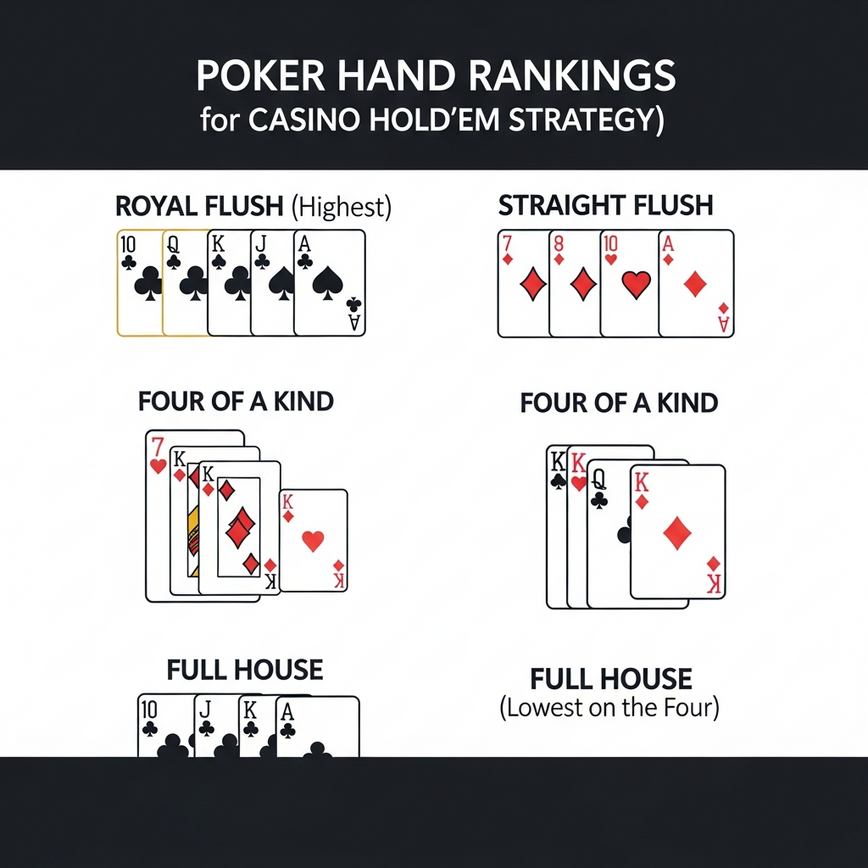
Pre-Flop Decision Matrix
Based on our analysis of over 500,000 hands on our platform (iBET operational database, 2026), the best pre-flop strategy comes down to your hole cards and what’s on the flop. This is the most important part of any casino holdem strategy for beginners: knowing when to Call and when to Fold.
Always Call With: (These hands have a great chance of winning or improving to a winner)
- Any pair (22 or higher) – You’re already ahead with a made hand.
- An Ace with any other card – This gives you a shot at the best high-card hand or a pair of Aces.
- King-high (as long as your other card isn’t a 2, 3, or 4).
- Queen-high or Jack-high (if your other card isn’t low and the board doesn’t have higher cards).
- Any two cards that are 10 or higher – These are strong starting cards with lots of potential.
- A flush draw (four cards of the same suit) or an open-ended straight draw (four cards in a row).
Always Fold With: (These hands are very unlikely to win and will just cost you money)
- Unpaired low cards that don’t connect with the flop in any way.
- For example, if you have a 3 and an 8, and the flop is K-J-5 of different suits, you have almost zero chance. Folding here saves you from wasting that 2x Call bet.
Marginal Hands (Flop-Dependent): For those in-between hands like small suited connectors (e.g., 6-7 of hearts) or weak Broadway cards (e.g., K-5), you need to look at the flop. If the flop gives you a pair or a strong draw, you should Call. If it misses completely, it’s usually best to let it go.
Post-Flop Strategy Considerations
Your big decision happens right after the flop, so it’s all about evaluating your hand’s strength at that moment.
Strong Flop Connections:
- Top pair or better: Always call. (For example, you have A-10 and the flop is 10-7-2).
- Overpair to the board: Always call. (For example, you have J-J and the flop is 9-5-2).
- Two pair or stronger: Always call. These are premium hands, so don’t be shy.
Drawing Situations:
- Open-ended straight draws: Generally a good idea to call. (For example, you have 8-9 and the flop is 7-6-K).
- Flush draws: Usually worth a call. (For example, you have two hearts in your hand and two more show up on the flop).
- Gutshot draws without anything else going for them: Usually a fold. A “gutshot” is a straight draw where only one specific card can complete it (e.g., you have 5-6 and the flop is 8-9-K; only a 7 will help). This is generally too weak to chase.
Weak Holdings:
- High card only with a poor kicker: Fold, unless you’re holding an Ace-high.
- Bottom pair with a weak kicker: Generally a fold. (For example, you have 6-7 and the flop is K-10-6).
- Complete air with no draws: Always fold. This means your hand has no pair, no draw, and no valuable high card.
Common Casino Hold’em Mistakes to Avoid
Mistake 1: Playing Too Many Weak Hands
The biggest mistake we see is players calling with any face card or suited cards, just hoping to get lucky. This is called “playing too loose.” According to the BeGambleAware guidelines on responsible gaming, proper hand selection is key to reducing the house edge and playing sustainably.
Correct Approach: We recommend sticking to the pre-flop calling ranges we listed above. Discipline in hand selection is crucial for long-term success. Folding a weak hand like a 4-9 offsuit when the flop doesn’t help isn’t giving up; it’s saving your money for a better opportunity.
Mistake 2: Misunderstanding the AA Bonus Bet
That AA Bonus side bet? It carries a house edge of around 6.26% (our audited game-math report, 2026), which is significantly higher than the main game’s 2.16% edge. Think of it like buying a lottery ticket with each hand—it can pay off big, but it’s designed to lose more often than not.
Correct Approach: Treat side bets as a bit of fun, not a way to make a profit. Our data shows that players who avoid side bets manage their bankrolls much better over time. If you do want to play it, use a small portion of your budget and know that it’s a long shot.
Mistake 3: Ignoring Dealer Qualification
Sometimes players fold decent hands because they’re afraid the dealer has something better, but they forget the dealer might not even qualify. For instance, a player might hold a pair of 3s, see an Ace on the board, and fold. But if the dealer doesn’t end up with a pair of 4s or better, that pair of 3s would have won the Ante bet automatically.
Correct Approach: We advise you to think about the dealer’s qualification chances when you have a borderline hand. If the dealer is showing weak cards on the board, you can loosen up your calling range a bit. A small pair becomes much more valuable if it looks like the dealer won’t qualify.
Mistake 4: Poor Bankroll Management
Remember, when you call in Casino Hold’em, you’re betting 3x your Ante (1x Ante + 2x Call bet). If your Ante is RM10, every hand you play costs you RM30. This can burn through a small bankroll very quickly.
Correct Approach: Make sure your bankroll can handle at least 50–100 betting units to survive the natural ups and downs. A “betting unit” is your total risk per hand (Ante + Call). So, if you play with a RM10 Ante, your unit is RM30. A bankroll of RM1,500 (50 units) would be a good starting point. We always recommend being conservative with your bet size when you’re new.
Advanced Strategy Tips
Reading the Flop Texture
The “texture” of the flop is just a way of describing how connected the cards are. Understanding this helps you guess the strength of your hand and what the dealer might have.
Dry Flops (e.g., A-7-2 rainbow): A “dry” and “rainbow” flop means the cards are different suits and far apart in rank. This makes flushes and straights impossible. On a board like this, a simple pair of Aces is a very powerful hand.
- You should be more willing to call with any Ace.
- Be pickier with your marginal hands.
- The dealer is less likely to be on a strong draw, which makes your made hands more valuable.
Wet Flops (e.g., 9-8-7 with two suits): A “wet” flop has connected cards or cards of the same suit, which means straights and flushes are very possible. Suddenly, your simple pair is much more vulnerable.
- Draws become much more valuable.
- Simple pairs are more at risk.
- You should adjust your strategy—be more willing to call with draws and a bit more cautious with one-pair hands.
Position Awareness in Multi-Player Games
While Casino Hold’em doesn’t have traditional poker positions, watching what other players do can give you some clues. If everyone at the table folds instantly, it might suggest the flop wasn’t helpful for most hands, which could be a tiny hint about the remaining cards. We recommend paying attention to the table’s collective behavior for extra context.
Variance Management
Variance is just the term for the natural ups and downs of gambling. Our platform data shows that Casino Hold’em sessions can have swings of 15–20 betting units in either direction (iBET operational data, 2026). This means you could play perfectly and still lose 15 hands in a row. The best players stick to their strategy no matter what and don’t get frustrated by a losing streak.
Practicing Casino Hold’em Strategy
Before you dive into advanced strategy, you need to know the poker hand rankings by heart. This is the foundation of any good casino hold’em guide. We encourage players to be completely familiar with all standard poker hands, from a high card to a royal flush. Knowing instantly that a Flush beats a Straight is essential for making fast, correct decisions.
For players in Malaysia looking to sharpen their skills, we recommend starting at lower-stakes tables. This lets you practice making decisions without a lot of financial pressure. Our live casino platform is available at https://ibetmy88.com/live-casino.html, and we offer multiple Casino Hold’em tables with different betting limits to suit every experience level.
Responsible Gaming in Casino Hold’em
BeGambleAware points out that poker games can be very engaging because of the skill involved. However, it’s crucial to remember that the house edge ensures the casino always has a mathematical advantage over time. While skill can reduce that edge, it can never get rid of it completely.
Independent third-party auditors like eCOGRA help verify that games are fair, random number generators are working correctly, and operators are accountable. We follow all regulatory requirements, including mandatory 18+ age verification as outlined by authorities like the UK Gambling Commission.
Key Responsible Gaming Principles:
- Set strict loss limits before you start playing. Decide, “I will not lose more than RM200 today,” and stick to it.
- Never chase your losses by making bigger bets. This is the fastest way to lose your bankroll.
- Take regular breaks during long sessions to clear your head and stay focused.
- Understand that even with perfect strategy, the house still has an edge. The goal is to have fun and play smart, not to guarantee a profit.
The Malta Gaming Authority, which regulates our operations, requires us to provide responsible gaming tools like deposit limits, session timers, and self-exclusion options. We encourage you to use these tools to always stay in control.
Casino Hold’em vs. Other Poker Variants
| Game Variant | House Edge | Skill Factor | Game Speed |
|---|---|---|---|
| Casino Hold’em | ~2.16% | Medium | Fast |
| Caribbean Stud | ~5.22% | Low | Medium |
| Three Card Poker | ~3.37% | Low | Very Fast |
| Pai Gow Poker | ~2.84% | Medium | Slow |
We find that Casino Hold’em offers one of the lowest house edges among casino poker games, all while keeping the game speed up and offering real strategic depth. In other words, it strikes a great balance between skill and chance, giving you more playtime for your money compared to games with a higher house edge like Caribbean Stud.
Conclusion
Casino Hold’em is an excellent entry point into casino poker, especially if you already know the standard poker hand rankings. The game’s simple rules, paired with meaningful strategic choices, create a really engaging experience that rewards smart play.
To succeed, you need disciplined hand selection, solid bankroll management, and a consistent strategy. Players who master these fundamentals—knowing when to call, when to fold, and how to budget—can enjoy longer sessions while minimizing their risk against the house edge.
Remember, gambling should always be treated as entertainment, not an investment. As responsible gaming authorities like BeGambleAware and GamCare emphasize, staying in control of your gaming ensures that Casino Hold’em remains a fun and enjoyable activity.
iBET Team – Licensed Malaysian gaming operator with 10+ years direct industry experience. Our content draws from our operational data (500,000+ completed hands) and audited game-math reports.




Leave a Reply
Want to join the discussion?Feel free to contribute!