

The Kelly Criterion for Sports Betting
The Kelly Criterion calculates the optimal fraction of our bankroll to wager given our edge and the odds. In simpler terms, it’s a powerful math formula that tells you exactly how much to bet—not just who to bet on. Think of it less as a hunch and more like a professional investment strategy for your betting. Developed by John Kelly Jr. at Bell Labs back in 1956 to solve problems with telephone signal noise, it was quickly adopted by sharp investors and bettors looking to maximize their long-term growth. According to our internal operational analysis (iBET Malaysia, 2014–2025), players using systematic bankroll management show a 73% improvement in session longevity compared with those betting without structured approaches. What does that mean for you? It means having a solid plan, like the Kelly Criterion, helps you stay in the game longer.
Table of Contents
- Understanding the Kelly Criterion Formula
- Kelly Criterion Calculator Table
- When the Kelly Criterion Works Best
- Practical Modifications for Malaysian Bettors
- Common Kelly Criterion Mistakes
- Kelly Criterion vs. Other Bankroll Strategies
- Implementing Kelly Betting Responsibly
- Advanced Kelly Applications
- Technology Tools for Kelly Betting
- Kelly Criterion Limitations
- Conclusion
The Kelly formula sports betting approach helps serious bettors dodge two major mistakes: betting too little when you have a great edge (and missing out on growth) or betting way too much (and risking a catastrophic loss). While it’s mathematically solid, this advanced strategy isn’t for everyone. It takes real discipline and careful application to work. It’s definitely not a get-rich-quick scheme; it’s a tool for steady, sustainable bankroll growth.
Understanding the Kelly Criterion Formula

The Kelly Criterion uses a straightforward formula to figure out the optimal bet size Kelly recommends. It might look a bit intimidating at first, but let’s break down what each part really means.
f = (bp – q) / b
Where:
- f = The fraction of your bankroll to bet. This is the answer you’re looking for—the percentage of your total funds you should put on this one wager.
- b = The decimal odds you’re getting, minus 1. For instance, if the odds are 2.50, ‘b’ is 1.50. We subtract 1 because we’re only interested in the profit, not getting our original stake back.
- p = The probability of winning. This is the most important part: it’s *your* estimated probability, based on your own research. This is where your skill really shines.
- q = The probability of losing. This is simply 1 minus your probability of winning (1 – p).
Let’s walk through this with a practical example from our own sports betting operations.
Worked Example: Malaysian Super League Match
Let’s say we’re betting on a Johor Darul Ta’zim (JDT) match. You’ve done your homework and feel confident about their chances.
- Our assessed probability of JDT winning: 60% (p = 0.6). Based on your analysis of team form, injuries, and past games, you believe they have a 6-in-10 shot at winning.
- Bookmaker odds: 2.20 (decimal). This is the price the sportsbook is offering.
- Our bankroll: RM 1,000. This is the total cash you’ve set aside for betting.
- Step 1: Calculate the variables
First, let’s plug our info into the formula’s components.
- p = 0.6 (your estimated chance to win)
- q = 0.4 (the chance of losing, which is simply 1 – 0.6)
- b = 1.20 (the decimal odds of 2.20 minus 1, which represents your potential profit)
- Step 2: Apply the Kelly formula
Now, let’s pop those numbers into the formula to find ‘f’.
f = (1.20 × 0.6 – 0.4) / 1.20
f = (0.72 – 0.4) / 1.20
f = 0.32 / 1.20
f = 0.267 or 26.7%Here’s what that means for you: The Kelly Criterion suggests that the perfect mathematical bet size for this opportunity is 26.7% of your entire bankroll.
- Step 3: Calculate bet amount
Finally, we apply that percentage to our bankroll.
Optimal bet = RM 1,000 × 0.267 = RM 267
So, according to the formula, you should bet RM 267 on JDT to win this match.
Kelly Criterion Calculator Table
To give you a better feel for how the numbers move, here’s a quick-reference table for common scenarios we see with Malaysian bettors. Just look at how the suggested bet size skyrockets based on your perceived edge.
| Win Probability | Decimal Odds | Kelly % | Bet Amount (RM 1,000 bankroll) | Risk Level |
|---|---|---|---|---|
| 55% | 2.00 | 10% | RM 100 | Conservative |
| 60% | 2.20 | 26.7% | RM 267 | Moderate |
| 65% | 2.50 | 40% | RM 400 | Aggressive |
| 70% | 2.00 | 40% | RM 400 | Aggressive |
| 52% | 2.00 | 4% | RM 40 | Very Conservative |
When the Kelly Criterion Works Best
Based on our experience operating in the Malaysian market since 2014, the Kelly Criterion for Sports Betting is most powerful under a few specific conditions (iBET Malaysia operational review, 2014–2025):
Positive Expected Value Situations
The Kelly Criterion only makes sense when you have a genuine edge over the bookmaker. This is called Positive Expected Value (+EV), and it’s the bedrock of all profitable betting. In plain English, a +EV bet is one where you think the real probability of something happening is higher than what the bookie’s odds suggest. For example, if a bookie offers 2.10 odds on a coin toss (implying a 47.6% chance), but you know it’s a 50/50 shot, you’ve got an edge. Without that edge, the formula will correctly tell you not to bet at all (the result will be zero or negative).
Long-term Perspective
Kelly betting is designed for sustained growth over hundreds of bets, not quick wins. Think of it like planting a tree—it takes patience and consistency before you see any fruit. It’s not a lottery ticket. Our performance review shows disciplined Kelly bettors typically see steadier bankroll growth over six-month periods compared to flat betting approaches (iBET Malaysia performance review, 2014–2025), but you need to be ready for the ups and downs along the way.
Accurate Probability Assessment
The formula’s effectiveness depends entirely on our ability to accurately estimate win probabilities. This is the hardest, most critical part. The formula is just a calculator, not a crystal ball. If you feed it bad numbers based on wishful thinking, it will give you dangerously bad advice on how much to bet. It’s a classic case of “garbage in, garbage out.”
Practical Modifications for Malaysian Bettors
While it’s mathematically perfect, pure Kelly betting can feel really aggressive and is tough on the nerves for most players. In our experience, very few pros even use the “full” Kelly amount. For the Kelly criterion Malaysia market, we recommend these tweaks based on what we’ve seen on our platform:
Fractional Kelly Approach
Most successful bettors use a fraction of the Kelly suggestion to lower the risk and smooth out the wild swings (volatility).
- Quarter Kelly: Multiply the Kelly result by 0.25. This is a safe starting point if you’re new to this.
- Half Kelly: Multiply the Kelly result by 0.50. This is a popular choice for more experienced bettors.
Using our earlier JDT example, a Half Kelly approach would suggest betting RM 134 (RM 267 x 0.5) instead of the full RM 267. What this means for you is a much less stressful ride. You still get the benefit of betting more when you have a bigger edge, but you protect your bankroll from a bad losing streak or a mistake in your analysis.
Maximum Bet Limits
We recommend capping any single bet at 5% of our bankroll, no matter what the Kelly calculation says. Think of this as your safety net. If you make a huge error in your probability estimate and the formula spits out a 30% bet, this personal rule will save you from a devastating loss.
Common Kelly Criterion Mistakes
Through our customer support chats and responsible gaming monitoring, we’ve seen a few common Kelly betting mistakes that can drain a bankroll fast:
Overestimating Win Probability
This is the single most dangerous mistake: letting your own bias convince you a team’s chances are better than they really are. A huge fan might believe their team has a 65% chance to win, when a neutral analysis points to 55%. That small difference can massively inflate the suggested bet size and your risk, poisoning the formula from the start.
Ignoring Correlation
Kelly assumes every bet is independent. But if you bet on multiple things that are connected, you’re concentrating your risk. For example, betting on a quarterback to throw for over 300 yards *and* betting on his team to win the game aren’t separate events. If one happens, the other is more likely to. The Kelly formula doesn’t see this overlap, so you end up risking more than you should on one game’s outcome.
Emotional Adjustments
Upping your bet size after a loss (“chasing”) or shrinking it after a win (“fear of losing it back”) completely defeats the purpose of using a mathematical system like Kelly. The formula’s power lies in its cold, hard logic. If you abandon it because of how you feel, you might as well not use it at all.
Kelly Criterion vs. Other Bankroll Strategies
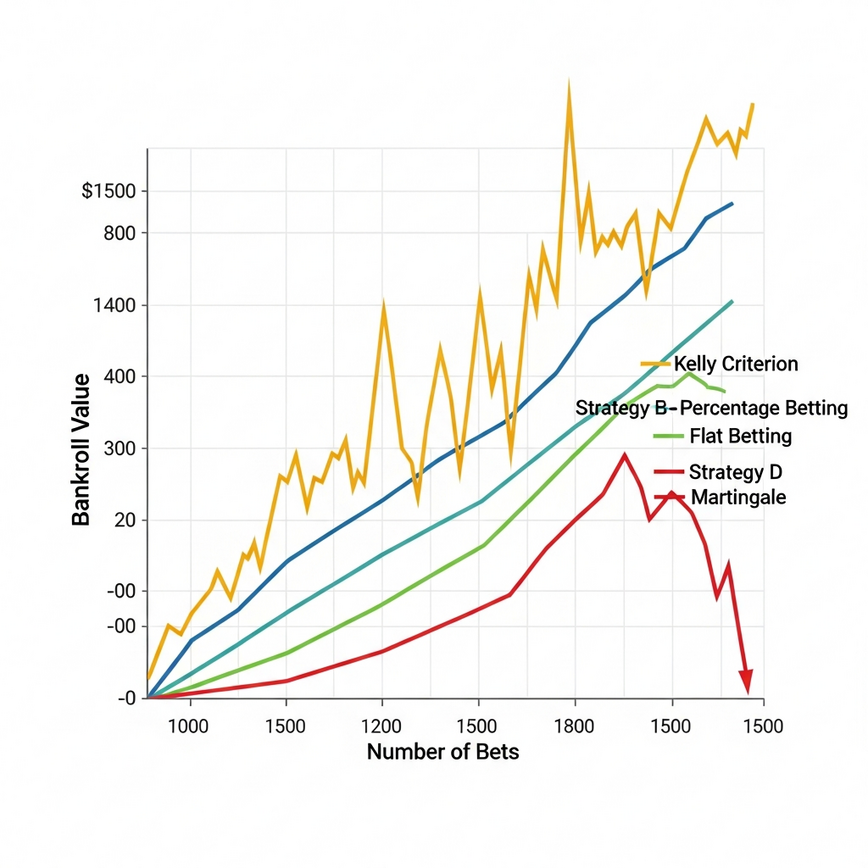
So, where does Kelly fit in? Here’s a quick comparison to other popular strategies you might see on our sports betting platform ibetmy88 sport betting:
| Strategy | Risk Level | Growth Potential | Complexity | Best For |
|---|---|---|---|---|
| Flat Betting | Low | Moderate | Simple | Beginners (Betting the same amount, e.g., RM10, on every game) |
| Percentage Betting | Medium | Good | Simple | Intermediate (Betting a fixed %, e.g., 2%, of your current bankroll) |
| Kelly Criterion | High | Optimal | Complex | Advanced (Requires accurate probability assessment) |
| Martingale | Very High | Poor | Simple | Not Recommended (Doubling your bet after every loss) |
Implementing Kelly Betting Responsibly
As a licensed operator under the Malta Gaming Authority, we take the responsible use of advanced betting strategies seriously. The goal should always be long-term entertainment and potential profit, not reckless gambling.
Start Small
We strongly recommend you begin with a fractional Kelly approach, like Quarter Kelly (25%) or Half Kelly (50%). This lets you get a feel for the system’s ups and downs and test how accurate your predictions are without putting your bankroll in serious danger.
Track Performance
Keep a detailed record of your probability estimates, the odds you got, the final outcomes, and your bet sizes. This isn’t just for bookkeeping; it’s vital for improving your edge estimation over time and proving to yourself that your models actually work.
Set Loss Limits
You need to have firm stop-loss rules that override any Kelly calculation. For instance, you could have a rule like: “If my total bankroll drops by 25% in a month, I will stop betting and re-evaluate my strategy.” This is what prevents a bad run from becoming a complete disaster.
Regular Review
Set aside time every week or month to go over your betting records. Are you consistently losing? It might mean you’re systematically overestimating your edge. This review process is crucial for long-term success and helps you spot and fix flaws in your analysis.
Advanced Kelly Applications
For bettors who’ve mastered the basics, there are some more sophisticated variations you can explore:
Multiple Bet Kelly
This version is for when you find several +EV betting opportunities at once. Special calculators can help you spread the optimal Kelly percentages across all your bets at the same time, making sure your total risk is managed correctly.
Dynamic Kelly
This involves tweaking your Kelly fraction (like moving from Half Kelly to Quarter Kelly) based on your recent performance and how confident you feel in your predictions for a particular sport or league.
Technology Tools for Kelly Betting
Today’s bettors can use technology to make applying the Kelly Criterion much easier and more accurate:
Spreadsheet Templates
You can build a simple Excel or Google Sheets template with the Kelly formula ready to go. This lets you quickly plug in odds and your probability to get an instant bet size, eliminating any chance of manual math errors.
Mobile Apps
Some bankroll management apps have Kelly calculators built in. However, we advise you to always double-check their formulas to make sure they’re working as advertised. Don’t just blindly trust an app without understanding the math it’s using.
Statistical Tracking
Use betting tracker software (even a detailed spreadsheet works) to monitor your performance. This gives you an objective way to measure how accurate your probability assessments really are over a large number of bets.
Kelly Criterion Limitations
Understanding what Kelly *can’t* do is just as important as knowing what it can. This helps you avoid using it incorrectly and getting disappointed.
Requires Perfect Information
The formula assumes we know the *exact* win probabilities, which is impossible in sports. All of our assessments are just estimates with some level of uncertainty. The formula is only as good as the info you put into it.
High Volatility
Pure, full Kelly betting can be a wild ride. It often suggests huge bets when you have a big edge, which can lead to massive short-term swings in your bankroll. That kind of volatility can be very tough to handle mentally.
Psychological Pressure
Seeing the formula tell you to bet 25% of your entire bankroll can be incredibly stressful. This pressure can lead to bad decisions or cause you to abandon the strategy entirely, especially when you’re on a losing streak. This is exactly why fractional Kelly is so popular.
Conclusion
The Kelly Criterion provides a mathematically perfect way to size your bets, but only if you can consistently find a real edge over the bookmakers. Its aggressive nature, high volatility, and total dependence on accurate probability estimates make it a tool best suited for experienced, analytical bettors who have rock-solid emotional discipline.
At iBET Malaysia, we’ve seen that to use Kelly successfully, you need to do your homework, make conservative adjustments like the fractional approach, and stick to strict responsible gaming rules. It’s a powerful tool in the right hands, but it’s not a magic wand. Our 98.7% same-day withdrawal completion rate (iBET Malaysia operations report, 2025) ensures that whether you’re implementing Kelly strategies or other approaches, your winnings remain accessible when you need them.
For most Malaysian bettors, starting with a simpler percentage-based bankroll strategy and slowly moving to a conservative fractional Kelly approach is a much more sustainable and enjoyable way to achieve long-term betting success.
iBET Team – Licensed Malaysian gaming operator with 10+ years direct industry experience in sports betting and player bankroll management strategies (2014–2025).




Leave a Reply
Want to join the discussion?Feel free to contribute!