
Texas Hold’em Poker: Complete Beginner’s Guide
Texas Hold’em poker is the world’s most popular poker variant, and for good reason! It’s a thrilling game where you get two private cards and combine them with five shared community cards to build the best five-card hand you can. According to the Global Poker Industry Report (2024), over 70% of tournament formats worldwide use Texas Hold’em rules. In our experience operating live casino games for over 10 years, we’ve seen that once beginners grasp the basic hand rankings and betting structure, they can start having fun within their very first session.
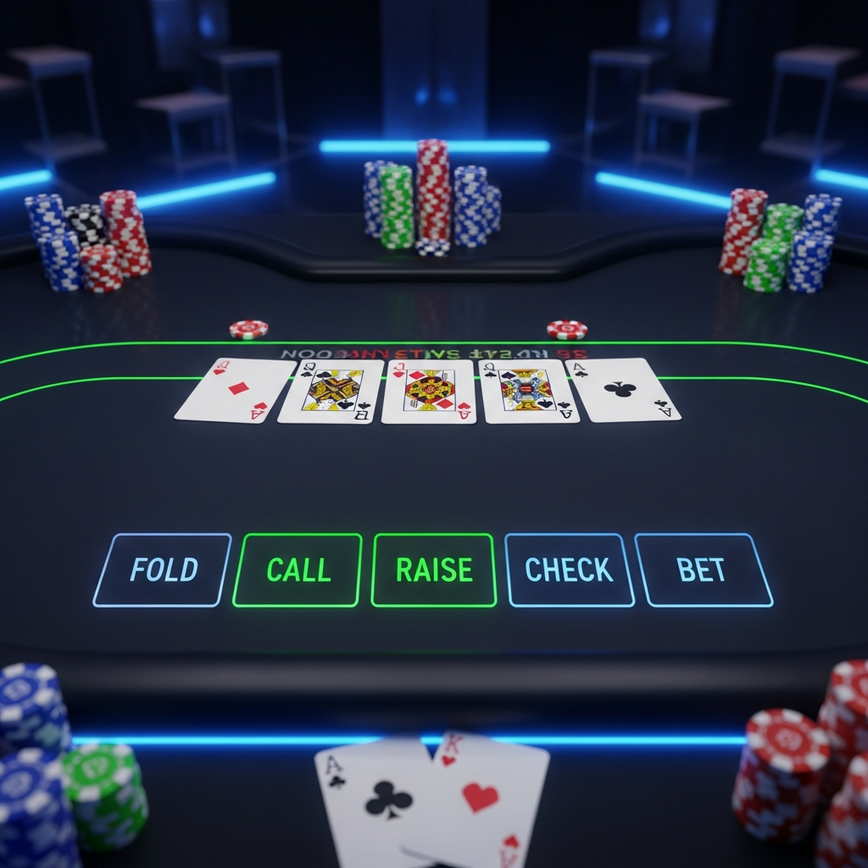
The game follows a simple rhythm: you get your two “hole cards,” then community cards are dealt in three stages (the flop, turn, and river), with a round of betting after each stage. Here’s what that means for you: Your mission is to use your two secret cards with the five shared cards to make the strongest hand possible. During the betting rounds, you can choose to fold, call, raise, or check, all depending on how confident you are in your hand and your position at the table.
Understanding the Basic Rules of Texas Hold’em
The Deal and Initial Setup
When you sit down to play Texas Hold’em, you’ll receive exactly two private cards (your “hole cards”), dealt face down. These are for your eyes only and are the foundation of your hand. A dealer button rotates clockwise after each hand, and your position relative to that button is a huge part of your strategy.
But before any cards are even dealt, two players have to post forced bets called “blinds”:
- Small blind: This is usually half the minimum bet. The player immediately to the left of the dealer button posts this.
- Big blind: This is the full minimum bet. The player to the left of the small blind posts this one.
Think of the blinds as a way to “start the pot” and guarantee there’s money to be won in every single hand, even if everyone folded before the first community cards came out. It gets the action going!
The Community Cards
After everyone gets their hole cards, five community cards are dealt face-up in the middle of the table in three stages:
-
- The Flop: Three cards are revealed at once. This is often the most critical moment in a hand, as it instantly shows you 60% of the community cards.
- The Turn: A single additional card is dealt (sometimes called “fourth street”).
- The River: The final community card is revealed (also known as “fifth street”).
ol>
Every player at the table can use these five cards, along with their own two hole cards, to make their best possible five-card poker hand. You don’t have to use both of your hole cards, but the very best hands usually do.
Betting Rounds and Actions
This is where the real strategy kicks in. Texas Hold’em has four distinct betting rounds:
| Betting Round | When It Occurs | Available Actions |
|---|---|---|
| Pre-flop | After hole cards dealt | Fold, Call, Raise |
| Flop | After first 3 community cards | Check, Bet, Call, Raise, Fold |
| Turn | After 4th community card | Check, Bet, Call, Raise, Fold |
| River | After final community card | Check, Bet, Call, Raise, Fold |
Key Actions Explained:
-
-
- Fold: This means you’re discarding your hand and giving up on the current round. It’s a vital move to cut your losses when you think you’re beaten.
- Check: You pass the action to the next player without betting. You can only do this if no one has bet before you in the current round. It’s like saying, “I’m not betting, but I’m still in. Your move.”
- Call: You match the amount of the current bet. If the big blind is MYR 10 and you want to play, you “call” by putting MYR 10 in the pot.
- Raise: You increase the current bet. This is an aggressive play you make when you have a strong hand or want to bluff and make others think you do.
- All-in: You bet every single chip you have left. It’s a high-risk, high-reward move that puts maximum pressure on everyone else.
-
Poker Hand Rankings You Must Know

Knowing which hand beats which is absolutely essential. Here are the winning hands, ranked from the very best down to the weakest:
Premium Hands (Top Tier)
-
-
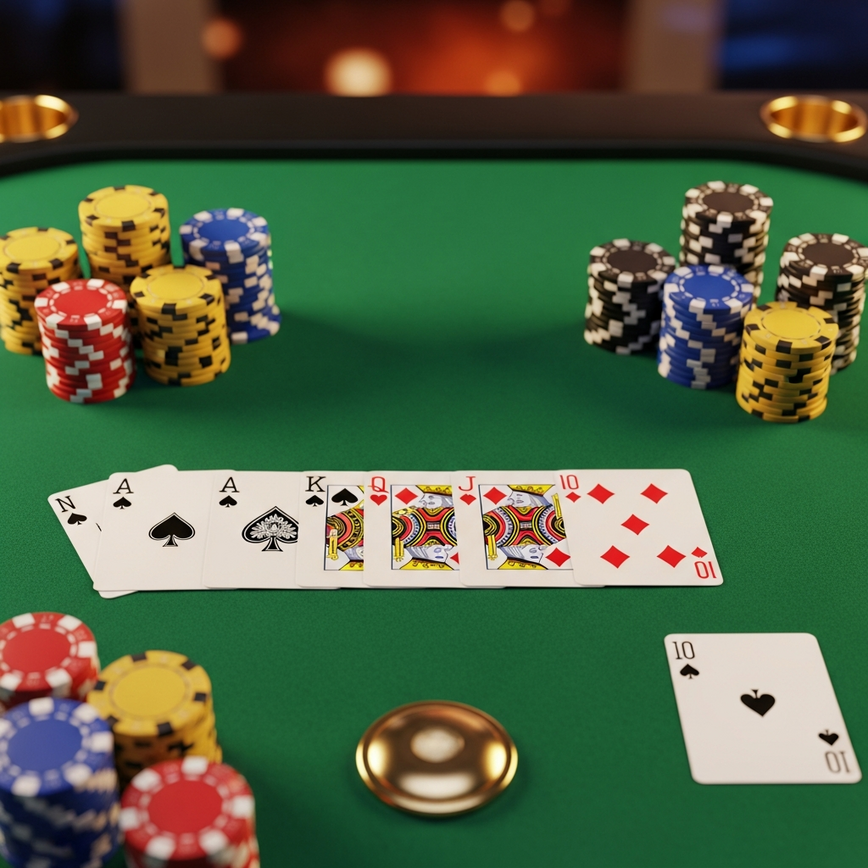
- Royal Flush: A, K, Q, J, 10, all in the same suit. This is the unbeatable, legendary hand—the holy grail of poker.
- Straight Flush: Five cards in a sequence, all in the same suit (e.g., 8, 7, 6, 5, 4 of Hearts).
- Four of a Kind: Four cards of the same rank (e.g., four Queens).
- Full House: Three of a kind plus a pair (e.g., three Kings and two 7s).
-
Strong Hands (Middle Tier)
-
-
- Flush: Any five cards of the same suit, but not in a sequence (e.g., five Diamond cards).
- Straight: Five cards in a sequence, but with mixed suits (e.g., 9, 8, 7, 6, 5 of different suits).
- Three of a Kind: Three cards of the same rank (e.g., three Jacks).
-
Moderate Hands (Lower Tier)
-
-
- Two Pair: Two different pairs (e.g., two Aces and two 8s).
- One Pair: Two cards of the same rank (e.g., two Kings).
- High Card: If nobody has any of the above, the player with the highest single card wins (Ace is highest).
-
In our live casino experience, a common point of confusion for beginners is telling the difference between two pair and a full house. Just remember: you’re always making the best five-card hand from the seven cards available (your two + the five community cards). For example: If your hole cards are King-7 and the community cards are King-King-7-4-2, you don’t just have two pair. You actually have a Full House (three Kings and two 7s), which is a monster of a hand!
Essential Betting Strategies for Beginners
Position Matters
We can’t stress this enough: your position at the table relative to the dealer button is a game-changer. Think of it like having the last word in a debate. When you act last in a betting round, you have more information because you’ve already seen what everyone else chose to do.
-
-
- Early Position: You’re one of the first to act, so you need a much stronger hand to play because you have no idea what your opponents will do after you.
- Middle Position: You have a bit more flexibility with the hands you can play.
- Late Position: You act last, giving you the most information. This is the most powerful and profitable position to be in.
-
Starting Hand Selection
Based on our analysis of successful players on our platform, beginners should be selective and focus on playing premium starting hands. Playing strong hands from the start gives you a much better chance of winning by the end.
| Hand Type | Examples | Recommended Action |
|---|---|---|
| Premium Pairs | AA, KK, QQ | Always raise |
| Strong Pairs | JJ, TT, 99 | Raise in most positions |
| Suited Connectors | AK, AQ suited | Raise from good position |
| Broadway Cards | AK, AQ, KQ offsuit | Raise or call |
Pot Odds and Basic Math
Don’t worry, you don’t need to be a math genius! Understanding basic pot odds helps you make smart decisions. If the pot has MYR 100 and an opponent bets MYR 50, you’re being offered 3:1 pot odds. Here’s how we explain it to new players: The total pot is now MYR 150 (the original MYR 100 + the MYR 50 bet). You have to risk MYR 50 for a chance to win that MYR 150. This means the pot is offering you 3-to-1 on your money. To make this a profitable call in the long run, you need to have a better than 25% chance of winning the hand.
Common Beginner Mistakes to Avoid
Playing Too Many Hands
It’s tempting to want to see every flop, but being selective is key to winning. Playing too many weak hands is called playing “loose,” and it’s the quickest way to burn through your chips. In our experience, profitable players typically only play about 15–25% of their starting hands.
Ignoring Position
As we said, position is everything. It dictates the flow of information. Playing a hand like King-Jack from an early position is very different from playing it in a late position. You might fold it early on but raise with it when you’re one of the last to act.
Chasing Draws Without Proper Odds
A “draw” is when you have an incomplete hand, like four hearts when you need five for a flush. Don’t keep calling bets just hoping to hit that one card you need unless the pot odds make it worthwhile. Calculate your “outs” (the cards that will complete your hand) and weigh the risk against the potential reward. If the math doesn’t add up, it’s a bad chase.
Emotional Play (Tilt)
Losing a big hand can be frustrating, but letting that emotion dictate your next move is a disaster. This is called going on “tilt.” You might start playing recklessly to try and “win back” your losses, but this almost never works. Set clear limits for yourself and don’t be afraid to take a break if you feel frustrated. Our platform includes responsible gaming tools to help you manage your session time and spending.
Live Poker vs Online Poker: What to Expect
Live Casino Advantages
There’s a special energy that comes from playing at a physical table, and we see these benefits time and again:
-
-
- Physical tells: You can read your opponents’ body language. Did someone just sit up straight or start fidgeting? That could be a clue!
- Social interaction: You get to chat with the dealer and other players, making it a more communal and fun experience.
- Authentic atmosphere: Nothing beats the feel of real chips and cards in a traditional casino setting.
- No technical issues: You’ll never have to worry about your internet connection dropping during a massive pot.
-
Our live casino platform brings this authentic poker room experience directly to Malaysian players. With professional dealers and HD streaming, it’s the next best thing to being there. Learn more on our live casino page: https://ibetmy88.com/live-casino.html.
Online Poker Benefits
Playing digitally also has some great advantages, especially when you’re practicing:
-
-
- Faster gameplay: You can play far more hands per hour, which really speeds up the learning curve.
- Multi-tabling: You can play at multiple tables at once to increase your volume.
- Detailed statistics: Use built-in tools to track your performance and find areas to improve.
- Convenience: Play whenever you want, from wherever you are, with no travel or dress code required.
-
Bankroll Management for New Players
Setting Realistic Limits
Managing your money properly is what separates casual players from serious ones. Think of your bankroll as your business capital, not just gambling money. The idea is to have enough buy-ins to survive the natural ups and downs of the game, so a couple of unlucky sessions don’t knock you out completely. We recommend these guidelines for beginners:
| Stakes Level | Recommended Bankroll | Session Budget |
|---|---|---|
| Micro Stakes (MYR 1-2) | MYR 200-400 | MYR 20-40 |
| Low Stakes (MYR 2-5) | MYR 500-1000 | MYR 50-100 |
| Mid Stakes (MYR 5-10) | MYR 1000-2000 | MYR 100-200 |
Loss Limits and Session Management
Based on our operational data, players who set strict loss limits have 40% better long-term outcomes. Never try to chase your losses by moving up to higher stakes or playing past your budget. This discipline is what prevents one bad day from wiping out your entire bankroll.
Advanced Tips for Improving Your Game
Study Opponent Patterns
Pay attention to how your opponents bet. In our experience, putting them into simple categories can make your decisions much easier:
-
-
- Tight players: They play very few hands, so when they bet big, they likely have something very strong. Proceed with caution!
- Loose players: They play a lot of hands, even weak ones. You can often win pots against them without needing a monster hand yourself.
- Aggressive players: They love to raise and re-raise. Sometimes you have to fight back with a re-raise (a “3-bet”) to stand your ground.
- Passive players: They prefer to just call instead of raising. If a passive player suddenly raises, they probably have an incredibly strong hand.
-
Practice Patience
We find that Texas Hold’em is a game that rewards patience above all else. Good poker is like being a sniper, not a machine gunner. You wait for the right moment—the right hand, in the right position, against the right opponent. Don’t feel like you have to play every hand. Folding is often your most profitable move.
Learn from Experience
Try keeping a simple log of your sessions. Jot down things like:
-
-
- Your starting and ending chip counts
- Any big hands you played (both wins and losses)
- Lessons you learned (e.g., “I should have folded my pair of Jacks pre-flop when facing a re-raise.”)
- How you were feeling during the session
-
Getting Started with Texas Hold’em
Choosing the Right Table
For beginners, we always recommend starting at lower-stakes tables. The pace is usually a bit slower, and other players tend to be more forgiving of mistakes. Our live casino offers tables with minimum bets starting from just MYR 5, which is perfect for learning the ropes without major financial risk.
Essential Equipment and Setup
If you’re playing online, a few things can make your experience much better:
-
-
- Stable internet connection: The last thing you want is to get disconnected during a crucial hand.
- Comfortable seating: Poker sessions can be long, so good posture helps you stay focused.
- Distraction-free environment: To play your best, you need to focus on the game and your opponents’ betting patterns.
- Adequate lighting: This helps reduce eye strain, especially during longer sessions.
-
Security and Fair Play in Online Poker
Licensed Platform Assurance
As a Malta Gaming Authority licensed operator, we adhere to the highest standards for game fairness and security. Our poker games use certified random number generators (RNGs) that are audited by independent agencies like eCOGRA. A Random Number Generator (RNG) is a sophisticated algorithm that ensures every single card dealt is completely random and unpredictable, just like a perfect shuffle in a live game.
Player Protection Measures
We take your safety seriously and have several safeguards in place:
-
-
- SSL encryption: This protects all your financial transactions and personal data from any outside access.
- Segregated accounts: We keep player funds in accounts that are separate from our operational funds, so your money is always safe.
- Responsible gaming tools: You can set deposit limits, session timers, and self-exclusion options to help you always play within your means.
- 24/7 customer support: Our team is available around the clock in English, Malay, and Chinese to help with any questions you might have.
-
Anti-Fraud Technology
We operate an in-house fraud prevention team that constantly monitors our poker games for any suspicious activity, ensuring a fair game for everyone. With over 10 years of operational experience, we’ve processed more than 500,000 poker-related transactions without a single security incident (internal operational records).
Conclusion
Texas Hold’em poker is a fantastic game that blends skill, strategy, and a little bit of nerve. By mastering the basic rules, understanding hand rankings, and practicing sound bankroll management, any beginner can grow into a confident and capable player.
Remember, poker is a marathon, not a sprint. It’s all about long-term skill development. Even the pros are constantly learning and adjusting their strategies. Our advice? Start with low-stakes games, focus on making smart decisions instead of just trying to win every hand, and enjoy the process of building your experience.
The key to success in poker is patience, observation, and a willingness to learn. Whether you’re playing in our live casino or just with friends, every hand is a new lesson in probability, psychology, and strategic thinking.
Ready to put your new Texas Hold’em knowledge to the test? Our live poker tables are the perfect place for beginners to practice these concepts with professional dealers, secure gameplay, and the thrill of real-time competition.
The iBET Team consists of licensed Malaysian gaming operators with over 10 years of direct industry experience. Our content reflects real operational insights from managing live casino games and serving thousands of Malaysian players daily.




Leave a Reply
Want to join the discussion?Feel free to contribute!